
Dear Rice community,
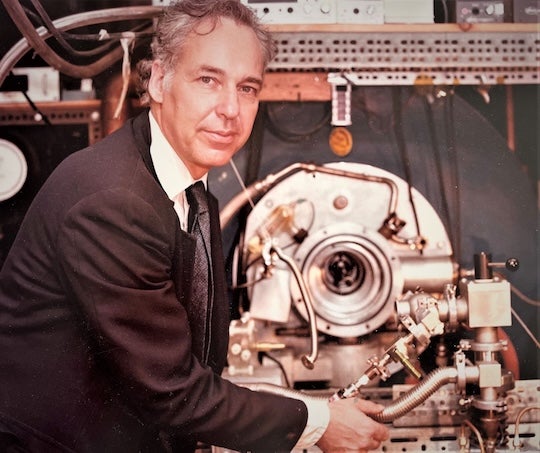
I am writing to share the sad news that Frank Tittel, a Rice professor and physicist whose career paralleled the rise of modern laser technology and who helped build Rice’s reputation in laser spectroscopy and trace-gas sensing over nearly six decades, died Feb. 17 at the age of 92.
Frank earned his bachelor’s, master’s and doctorate degrees, all in physics, from Oxford University, before beginning his research career in the U.S. He joined Rice in 1967 as an associate professor of electrical and computer engineering, following research posts at the General Electric Research and Development Center in Schenectady, New York, and the American University in Cairo. In 1973, Frank was promoted to professor and named the J.S. Abercrombie Professor of Electrical and Computer Engineering in 1989. He later served as department chair from 1992 to 1995 and led the Rice Quantum Institute, which became the Smalley-Curl Institute in 2015, from 1996 to 2000.
Frank’s scientific legacy involves helping advance laser spectroscopy, quantum electronics and pioneering work in laser-based sensing of gases at minute concentrations, with applications in environmental monitoring, chemical analysis, industrial process control, security and defense applications and medical diagnosis. He was a close collaborator of Robert Curl ’54 and Richard Smalley, who shared the Nobel Prize in chemistry in 1996. A spectroscopy technique developed by Frank in collaboration with Robert and colleagues made possible the development of highly sensitive, yet compact and rugged sensing devices used in field applications ranging from projects at NASA’s Johnson Space Center related to air and water quality for the International Space Station, Environmental Protection Agency monitoring of formaldehyde in urban environments, and National Institutes of Health-supported studies of noninvasive detection of nitric oxide and carbon monoxide in biomedical systems.
Colleagues and former students said his steadfastness, dedication, attention to detail, and generosity as a mentor and friend left as deep a mark as his scholarship.
I invite you to read more about his career in Rice News.
Warm regards,
Amy Dittmar, Howard R. Hughs Provost and Executive Vice President for Academic Affairs